The Architecture of Camouflage

What lurks behind these empty walls? (Image By: heydayjoe)

Hey, 400 block of 8th Street NW! Powell Elementary’s Drama Club called — they want their stage sets back! (Image By: heydayjoe)

If you’re a sharp-eyed passerby, or simply sighted, you may have noticed these lackluster building facades along 8th Street NW between D & E. What are they hiding?

Perhaps it’s the “Danger – High Voltage” signs hanging on the concrete doorways that give it away. Or maybe it’s the white trucks with the blue and green logo driving in and out of the buildings.

Despite some telltale signs of what hides behind these walls, we have to give props to these props. Though the design of these false fronts is far from grandiose, it does blend into the neighborhood better than, say, a concrete bunker surrounded by barbed-wire fencing, like one you might find at…

Pepco substation.

Yes, these phony facades hide a power substation of the Potomac Electric Power Company, aka Pepco, a large utility that serves Washington, DC, and the surrounding area. But why here, on a piece of prime real estate in trendy Penn Quarter? The answer: location. Substations have to be close to the neighborhoods they serve, and as the condo towers continue to rise, this substation in disguise is dishing out more power every day.

Thank you for your interest but due to security concerns we do not disseminate the type of information you have requested about our electric system. I apologize for not being able to accommodate your request.

Heyday contacted Pepco to get the scoop on this substation and others. When were the fake facades on 8th Street created? How much is the real estate they’re located on worth? How many substations are there in DC proper? The answers to these questions? We’ll never know, because Pepco wants to keep its utility under the radar. The quote to the right is the official response from Bob Hainey, Pepco’s media relations manager.

For the record, Heyday DC poses no nefarious threat; we are not that tricksy and our addiction to electricity leads us to respect Pepco’s right to substation secrecy. So Pepco, you keep hiding and we’ll keep seeking.

Pepco – giving you energy and light, while hiding in plain sight…

[UPDATE: The good people at the Washington DC History Network (@H_DC_DCHistory) pointed us to a 1997 Washington Post story with more information about the mysterious facades. The building fronts on this section of 8th Street NW are historical fragments from buildings that once stood along Pennsylvania Avenue. Starting with the building on the left (south) in the above photo, the facades are from Bassin’s, Washington’s first sidewalk cafe, originally located at 14th and Pennsylvania; Kann’s, once DC’s second largest department store, in the 700 block of Market Space (a three-bay cast-iron segment); 1201 Pennsylvania Ave., originally constructed in the 1890s and torn down in the 1960s to make way for the first modern office building on the west end of Pennsylvania Ave.; 405 7th Street NW; and 819 and 817 Market Space NW. It sure would be nice to have a commemorative plaque here that describes the origin of these building facades…]
Holding Out for Some Heroes

(Photo By: heydayjoe)

(Photo By: heydayjoe)

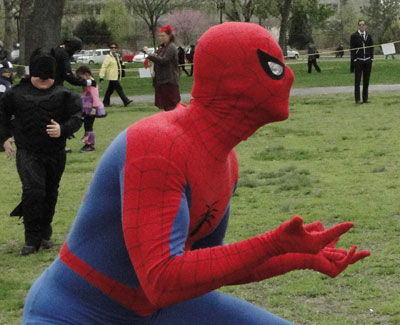
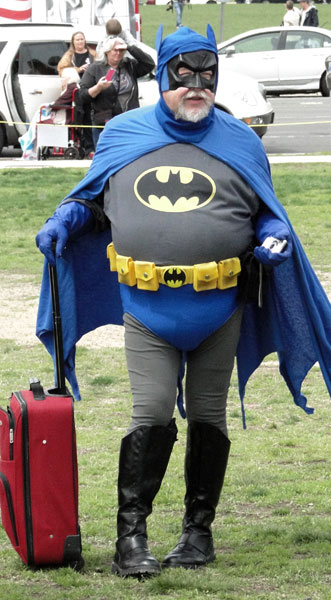
On Friday, DC’s Awesome Con, a self-described “comic-con that embraces all aspects of geekdom and pop culture,” attempted to break the Guinness World Record for most assembled costume players photographed at one time. The clarion calls went out through social media, microphones and bullhorns for all superheroes (and villains) to meet at noon at the Reflecting Pool in front of the U.S. Capitol. The goal was to beat the current world record held by China’s World Joyland, the Chinese equivalent of Disneyland, which gathered 1,530 costumed characters on April 19, 2011.

There must have been a confluence of worldwide calamities yesterday, because only 237 superheroes showed up – and most of them were under four feet tall.

Heyday DC was there on the National Mall to witness this grand fizzle of a nonhistoric non-event. Click on the photos below to see some of our favorite costumed crusaders.


Overheard: Spider-Man Caught in Political Web

(Photo By: heydayjoe)

(Photo By: heydayjoe)


Welcome to the second in our series of eavesdropped conversations.

[We couldn’t help but overhear your private conversation in a public place.]


EXT. NATIONAL MALL, NEAR REFLECTING POOL IN FRONT OF U.S. CAPITOL BUILDING – JUST AFTER NOON

Hundreds of costumed crusaders are gathered in an attempt to break the Guinness World Record for most assembled costume players gathered in one place. Cameramen and reporters swarm the crowd looking for the inside scoop on how it feels to pretend to be a superhero. A reporter confronts one of the more authentic-looking spider-men, among a half-dozen imposters.

FEMALE REPORTER

Spider-Man. Can I ask you a question?

SPIDER-MAN

[strikes superhero pose with hands on hips, feet in a wide stance and head held high)

Yes!

FEMALE REPORTER

What do you think of the funding being given to science programs in elementary schools?


T. Rex Finds New Home in DC – Rent-Free!

    DC's resident T. rex arrives at the loading dock of the Smithsonian National Museum of Natural History in the wee hours of April 15, 2014. (Photo By: heydayjoe)

DC’s resident T. rex arrives at the loading dock of the Smithsonian National Museum of Natural History in the wee hours of April 15, 2014. (Photo By: heydayjoe)

You know that colossal T. rex skeleton that towers over you as you enter the dinosaur hall in the Smithsonian National Museum of Natural History? It’s a fake – but not for long. This morning at 5:30 a.m., a FedEx 18-wheeler pulled into the parking lot with the real skeletal remains of a genuine T. rex.

Federal Express – When your dinosaur absolutely, positively has to be there overnight.

For the first time since the dinosaur hall opened in 1911, the Museum of Natural History will have a bona fide Tyrannosaurus rex gracing its space. This 38-foot long, 7-ton T. rex is on loan to the Smithsonian Institution for 50 years, and we owe its discovery to a Montana woman out camping with her family.

The first bones of DC’s new T. rex were discovered in 1988 by Kathy Wankel, a rancher who found the dinosaur’s arm bones near the Fort Peck Reservoir in northeast Montana, on land owned by the U.S. Army Corps of Engineers. Christened the Wankel T. rex, the dinosaur was kept by the Corps at the Museum of the Rockies in Bozeman for nearly 20 years until it was packed up and shipped to DC.

Shipping a T. rex isn’t as hard as it may sound. In some ways, it’s like sending a care package to college. Wrap it up, put it in a box and toss the box onto a truck. Only this care package nixed the bubble wrap in favor of custom-molded plaster cradles. And it came in 16 crates in a customized FedEx truck driven by a husband and wife team. The couple left Bozeman in a 53-foot-long semi on April 11 for the more than 2,000-mile trip – and arrived on time.

Time to unload the dinosaur (Photo By: heydayjoe)

Time to unpack the dinosaur (Photo By: heydayjoe)

Back in 1997, the Museum of Natural History was on the verge of getting a real T. rex — a dino named Sue. Sue, the largest and most complete Tyrannosaurus rex ever discovered, was to be auctioned by Sotheby’s to the highest bidder. The Smithsonian thought it belonged in its dinosaur collection. To bring Sue home to DC, the world’s most-visited natural history museum was prepared to spend $2.5 million. It wasn’t nearly enough. The Field Museum of Natural History in Chicago drastically outbid the Smithsonian, spending $8.3 million to bring Sue home to Chicago, where the 67-million-year-old remains the star attraction, drawing more than 6.5 million visitors.

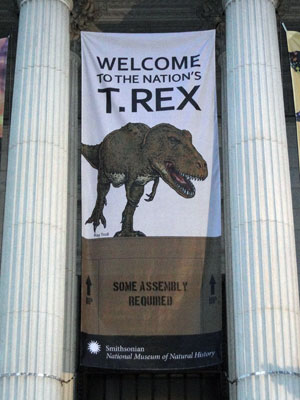
Some assembly required -- eat your heart out, Ikea. Yes, this T. rex would eat your heart out, Ikea. (Photo By: heydayjoe)

SOME ASSEMBLY REQUIRED — just like Ikea! (Photo By: heydayjoe)

Since that fated auction, the Smithsonian National Museum of Natural History has been looking for an alternative T. rex to complete its collection – until now. To make room for the big guy, the dinosaur hall will close on April 28 for a five-year renovation. When the hall reopens in 2019, the Wankel T. rex is set to be the centerpiece of a new paleontology exhibit that will showcase the giant carnivore like never before.

Now that will be something you can sink your teeth into…

[DINOSAUR BONUS: The Ohio State University marching band does a great T. rex impression. To see the beast in action, scroll to the 1:30 mark in the video below.]

Cherry Blossom Haikus 2014

This past weekend brought to a close the three-week National Cherry Blossom Festival in DC. When the trees reached peak bloom last Thursday, we asked readers to send their best haikus about the cherry blossoms in DC. Here are our favorites.

(Illustration By: Matt Wainwright)

(Illustration By: Matt Wainwright)


the beaver vandals
hide in the day, but at night
they eat your blossoms

— Heydaisy from DC

Days, at last, longer.
Pink snow falls and starts dancing
along DC streets.

— Laura from Kiev, Ukraine


(Photo By: Heydaisy)

(Photo By: Heydaisy)


As blossoms emerge,
Tourists swarm the city streets.
Blooming idiots.

— Jim from Lanham, Md.

The gifts from Japan,
Cherry trees pique appetites.
Sushi, wasabi.

— Jim from Lanham, Md.

A brief Spring rises
March into April’s Pink bliss
Time to fornicate

— Badge from Taipei, Taiwan

As American as Cherry Pie … and Sushi

National Cherry Blossom Festival in Washington DC

She wants to do with Pablo Neruda what spring wants to do with the cherry trees. (Photo By: heydayjoe)

Each spring, thousands make their annual pilgrimage to DC to gaze in awe at the riotous blooming of the Japanese cherry trees. Poet Pablo Neruda, distinctly not Japanese, once wrote, “I want to do with you what spring does with the cherry trees.” Although we think that’s pretty hot, it has nothing to do with the history of the cherry trees in Washington, DC.

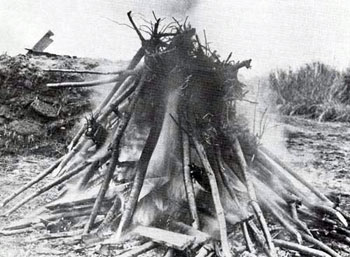
The first shipment of Japanese cherry trees arrived in DC in 1910, a gift from the city of Tokyo intended as a gesture of friendship and goodwill between the people of Japan and the United States. When the trees arrived, however, they were so infested with insects and parasitic worms that there was no easy way to re-gift them to another country. So President Taft agreed to have them incinerated in a heaping big bonfire. Many thought this was no way to accept a gift.

Nothing says "thank you" like burning your gift in a bonfire. (Source: U.S. National Arboretum)

Because nothing says “thank you” like burning your gift in a bonfire… (Source: U.S. National Arboretum)

After much diplomacy to smooth over the embarrassing burning of the gift, in 1912 the people of Japan sent a new bug-free shipment of 3,020 cherry trees, and these were planted along the Potomac River. First Lady Helen Herron Taft and the wife of the Japanese ambassador planted the first two cherry trees on the northern bank of the Tidal Basin, and workmen planted the rest around the Tidal Basin and East Potomac Park. (The two original trees are still there, near the John Paul Jones statue at the south end of 17th Street.)

In 1965 Japan gave First Lady Lady Bird Johnson (that’s a mouthful) 3,800 more trees to plant, and today there are 3,750 trees of 16 varieties on national parkland in DC.

This year marks the 102nd anniversary of the original gift of friendship from Japan, although on the 39th anniversary, Japan bombed Pearl Harbor, so how’s that for friendship? Four days later, four cherry trees were chopped down in suspected retaliation. The culprits were never caught. To prevent further attacks against the trees, the Cherry Blossom Festival was suspended during World War II (resuming in 1947), and the trees were referred to for the remainder of the war as the “Oriental” flowering cherry trees.

This wasn’t the end of the cherry tree assaults though. In 1999, the trees were attacked once more. But this time they found the vandals – beavers! The beavers were forcefully removed from the Tidal Basin, and fences were erected around some of the more defenseless trees.

Beaver Vandals (Illustration By: Matt Wainwright)

Beaver Vandals (Illustration By: Matt Wainwright)

If you’d like to take a gander at these celebrity cherry trees, you can find them in three National Park Service locations: around the Tidal Basin in West Potomac Park, in East Potomac Park (Hains Point) and on the grounds of the Washington Monument. (For more info on the varieties of cherry trees and their locations, click here.)

Some random facts about the DC cherry blossoms:

(Photo By: heydayjoe)

(Photo By: heydayjoe)

  • The National Cherry Blossom Festival is scheduled every year based on when the National Park horticulturalists predict peak bloom, but nature doesn’t always cooperate. The weather determines when the trees will bloom, and sometimes it’s not during the festival.
  • Most of the trees are of the Yoshino variety, and the average blooming date for the Yoshino cherry trees is April 4.
  • Peak bloom is defined as the day on which 70 percent of the blossoms of the Yoshino trees open.
  • The earliest blooms were on March 15 in 1990.
  • The latest blooms were on April 18 in 1958.
  • The Kwanzan cherry tree, the second-most-numerous variety between the Tidal Basin and Hains Point, blooms two weeks after the Yoshino trees. So if you’re a late bloomer, you still have a shot at seeing some blossoms.

To commemorate this perennial event, please submit your very own cherry blossom haiku by email or in the comments below. We’ll read them all and publish the best of them.

Here are two to get you started…

tourists swarm around

cherry trees in luscious bloom

as if sedated


the beaver vandals

hide in the day, but at night

they eat your blossoms


J. Edgar Hoover Ends FBI Legacy Behind Bars

J. Edgar Hoover's gravesite at Congressional Cemetery (Photo By: heydayjoe)

J. Edgar Hoover’s gravesite at Congressional Cemetery (Photo By: heydayjoe)

J. Edgar Hoover, longtime Director of the FBI – the man who spent his life putting others behind bars – spends his eternity behind bars at Congressional Cemetery on the west bank of the Anacostia River in Southeast Washington.

The only civil servant to be honored with a state funeral, Hoover served as the head of the FBI for 48 years, from 1924 until his death in 1972. Though his legacy is tainted because of the illegal methods of infiltration, planted evidence and burglaries he condoned, his name is carved in stone at the FBI headquarters on Pennsylvania Avenue.

A master of blackmail (not to mention bigotry), Hoover loved illegally wire-tapping people to get dirt on them, especially those he detested. He spent countless agent hours and taxpayer dollars snooping on Martin Luther King, determined to prove him dangerous by proving him immoral. And he hated author John Steinbeck so much (convinced that he was a red Communist) that he had the IRS audit him every year.

To J. Edgar, the highest realms of patriotism and virtue were reflected in his personal prejudices and wholesome lifestyle.

J. Edgar Hoover and Clyde Tolson enjoy a ride in Atlantic City, NJ.

J. Edgar Hoover and Clyde Tolson enjoy a ride in Atlantic City, NJ.

A lifelong bachelor and creature of habit, J. Edgar ate lunch at the same hotel restaurant every workday for 20 years with the same companion, his lifelong friend and FBI protégé Clyde Tolson. (The Mayflower Hotel’s restaurant is now named Edgar Bar & Kitchen in his honor.) He never strayed from his daily order – chicken soup, white toast, half a grapefruit, cottage cheese and Bibb lettuce – and he never tipped back a martini. A teetotaler, Hoover forbade the use of intoxicating beverages by any FBI agent, on or off the job.

In his quest to get “subversive” Americans, J. Edgar didn’t have time for frivolity. Even a party song like the Kingsmen’s “Louie Louie” aroused suspicion. For two and a half years he had his underlings investigate the song to find hidden sexual messages. The process included interviews with author Richard Berry and members of The Kingsmen as well as repeated listenings of the song at various speeds. The verdict: The study found no evidence of obscenity, concluding that the song was “unintelligible at any speed.”

A DC native, J. Edgar was reportedly born in 1895 at 413 C Street SE, later known as 413 Seward Square SE and now the site of the Capitol Hill United Methodist Church. We say “reportedly” because, unlike his two siblings, there is no record of his birth. As a teen, he competed on the debate team and sang in the school choir at Central High School, now known as Cardozo. He later obtained both his law degree and his Masters of Law at George Washington University.

From 1940 until his death in 1972, J. Edgar lived at 4936 30th Place NW (Forest Hills), where he kept files on Supreme Court justices, members of Congress and U.S. presidents. When the current owners moved in, they had the bulletproof-glass windows removed.

When Hoover died, Tolson – his lunch buddy, life partner and possible lover – inherited his estate and moved into the house. Tolson is also buried at Congressional Cemetery, a few yards from J. Edgar.

Burial sites are still available to the general public.