Wish We Here — DC Postcards #9

Happy Summer Solstice 2014, the longest day of the year! Here’s our latest altered DC postcard, encouraging you to tour DC’s Space Needle, follow the National Arboretum trail to the top of Mount Hamilton (240 feet above sea level!), kayak Rock Creek (if the water’s at least two feet deep!) and visit a farm(ers market). Just remember: No matter what you do this summer weekend, Obama will be watching you…

DC postcard

(Image By: Matt Wainwright)

FDR and Friday the 13th

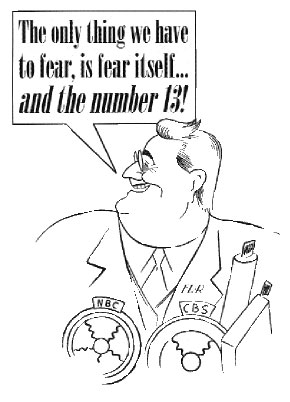
FDR friday 13thPresident Franklin Delano Roosevelt had a mild case of triskaidekaphobia — he didn’t like the number 13. He refused to travel on the 13th day of any month and would not sit down with 13 at dinner or host a dinner party with 13 guests.

FDR especially hated Friday the 13th. He would never start an important trip on a Friday, particularly the 13th. But as it turned out, Friday the 13th wasn’t out to get him after all.

FDR died on Thursday the 12th (April 12, 1945).

Today Washington DC Became Capital of the United States

The U.S. Capitol as it appeared circa 1800, when DC became capital

The U.S. Capitol as it appeared circa 1800 when DC became capital, in a watercolor painting by William Russell Birch (Image Courtesy of Library of Congress)

On June 11, 1800, DC became capital of the United States, leaving the country’s former capital of the previous decade, Philadelphia, to the fate of Pennsylvanians. While Washington, DC, was a young upstart, Philadelphia was the largest city in America at the time, with nearly 50,000 residents.

George Washington never saw the city named after him become the capital of the new nation; he had died more than six months before – his last words: “Tis well.”

In 1800, the U.S. Capitol building consisted only of the Senate’s north wing. The Senate and House members shared this wing until a temporary wooden pavilion was built for House members. Their south wing was finally completed in 1811, but the House members didn’t wait – they left their pavilion and moved into the unfinished wing in 1807.

At this time of the capital move from Philly, there were only about 125 federal employees newly bound for DC, and official documents and archives were transferred by ship via inland waterways.

President John Adams had to move, too, but the “President’s Palace” – which wouldn’t be called the “White House” until 1811 – was still under construction. Instead, Adams took a room over Tunnicliff’s, a Capitol Hill tavern at the corner of 1st and A NE. Good to know that our first DC resident President lived over a bar…

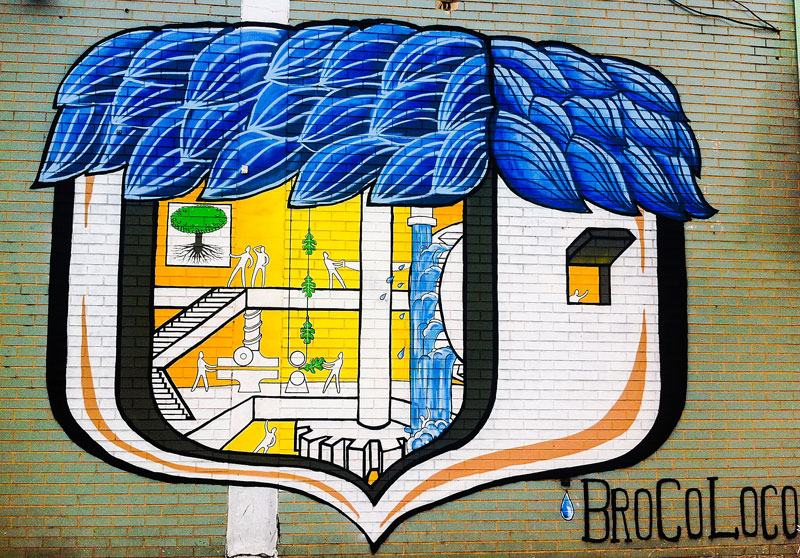
DC as Canvas: “WallNut” Acorn H Street Art by BroCoLoco

"WallNut" by BroCoLoco, on H Street NE (Image By heydayjoe)

“WallNut” acorn mural by BroCoLoco, on H Street NE  in DC’s Atlas District (Image By heydayjoe)

We used an acorn with a cross section showing all the parts of the future oak being constructed within it to indicate that just because you don’t see growth on the surface, there’s still a lot going on behind the scenes.” — BroCoLoco

Created by the brotherly team BroCoLoco, the “WallNut” acorn H Street art appears on the side of the former Korame Home Products building at 620 H Street NE in the Atlas District. Commissioned for the 2013 H Street Festival, this acorn mural helps bring a little life to a mind-numbing stretch of blank beige wall – a wall that won’t exist for very much longer thanks to the sponsors of the mural, Insight Property Group.

Founded in 2012 and headquartered in Lexington, Ky., the Brothers Company Art Venture (aka BroCoLoco) is Aaron and Jared Scales’ design collaboration, which offers “storytelling services through art, architecture, branding, marketing & design.” Older brother Aaron is an architect who’s designed U.S. embassies and an award-winning Kentucky bus shelter. Jared is a sous chef on the side. The brothers have traveled to nearly 30 countries and use their travels as inspiration for global humanitarian endeavors. BroCoLoco donates funds to sponsor children through both Children International and ChildFund.

But let’s get back to the transected acorn. Just to the left of “WallNut” appear the phrases “Apollo Returning to H Street Soon” and “Mighty oaks hide in small seeds.” From 1913 to 1955, the Apollo Theatre, an ornate early Washington movie theater, stood here at 624 H Street NE. Like so many other once-cherished sites now demolished, the Apollo will live on in the massive new development taking its name. The $120 million Apollo H Street will include 321 residential units, 74,000 square feet of retail, more than 440 parking spaces and bicycle parking.

Say goodbye to longtime neighbors Murry’s Fine Foods, Korame Home Products, Good Danny’s Carry Out and H Street Storage. All will be closing this summer to make room for the mixed-use community, which will include a Whole Foods. The project, developed by acorn mural sponsors Insight Property Group, breaks ground in the fall. As for the “mighty oaks” phrase, yeah, we get it: Marketers have been co-opting the “great things come from small beginnings” idea for centuries, as in, great big new buildings come from the demolition of smaller older buildings.

BONUS: In addition to being artists, designers, photographers and self-proclaimed “creative extraordinaires,” the BroCoLoco brothers are also musicians. This video of “Hello Goodbye” should make it clear why we say hello to their murals and goodbye to their music.

Union Station Roman Legionnaires: Behind the Shields

More than 90,000 visitors pass through Union Station daily and, thanks to a group of foresighted railroad officials now long dead, most of those visitors will never have to see a Roman legionnaire’s sculpted man parts.

Back in 1906, American sculptor Louis Saint-Gaudens was under contract with the railroads to create a series of interior and exterior statues for the massive Union Station train depot being developed a few blocks north of the U.S. Capitol. Louis was the brother of famed American sculptor Augustus Saint-Gaudens, who created the bronze Adams Memorial in Rock Creek Park.

As the Roman legionnaire symbolized the far-flung reaches of the Roman Empire, so these figures symbolize the far-flung ribbons of steel of the vast network of the American railroads reaching every part of the United States.” — George J. Olszewski, “Construction History of Union Station, Washington, D.C.”

For Union Station’s interior, the main sculptural theme was to be Roman legionnaires, to complement architect Daniel Burnham’s Beaux-Arts style modeled after the Roman baths. Upon official railroad approval of a plaster model to be submitted in advance, Saint-Gaudens would then complete 46 carved soldiers. Perched atop the arches over the entrances and exits of the main waiting room, these larger-than-life statues of Roman legionnaires would dutifully watch over the Union Station travelers below.

When Saint-Gaudens submitted his plaster model of the legionnaire, though, there was one small problem: You could see his package. And it wasn’t wrapped. To be clear, the soldier’s wee willy wasn’t even a proper Roman penis — more of a nubbin really. But the officials of the Baltimore & Ohio and Pennsylvania Railroads were having none of it – there would be no sexy soldier legs or any other bareness beneath the belt.

Although the pants-free lifestyle was typical of the Roman legionnaire, railroad officials believed it would cause undue embarrassment for little old ladies visiting Union Station to be exposed to the towering genitalia of rock-hard Roman legionnaires. They felt Union Station was designed to be a noble transportation hub for our nation’s capital, not a giant Roman bathhouse with leering legionnaires gone commando. Louis Saint-Gaudens was urged to alter his model.

Jarrett Hendrix (@briliantartistry) takes a photo of a Roman legionnaire's junk. (Photo By: heydayjoe)

Jarrett Hendrix (@brilliantartistry) takes a photo of a Roman legionnaire’s junk. (Photo By: heydayjoe)

Louis tried to convince the prudish railroad officials of the architectural significance of the symbolic figures, but they were adamant that no sculpted man-bits would appear in their new train station. After many meetings (for which we wish we had the transcripts), Saint-Gaudens proposed a solution: Why not place a shield in front of the legs of each legionnaire, held by his right hand (so station travelers would know what that right hand was up to), and thus covering the objectionable hint of phallus the whole way from feet to hips, just to be sure. The railroad officials conceded that this was an adequate manhood cover, and the shields were incorporated into the final design.

The 46 legionnaires were hollow cast in plaster with a sand finish and arranged in pairs over arches. Of these, 36 appeared in the main hall: 10 facing inward from the north gates to the concourse, 10 over exits from the station and eight each on the east and west sides. Six soldiers appear under the main portico above the doors to the main hall, with four more in the west hall. In addition to these figures, Saint-Gaudens created the six enormous stone statues on the façade facing Union Station Plaza and the U.S. Capitol. The more than 50 statues he created for Union Station are considered his life’s masterwork.

Within six years of his contract, Saint-Gaudens had completed carving all of the statuary for both the interior and exterior of Union Station. He was paid $52,044.10 for his work. In 1913, the Roman legionnaire statues were set in place. That same year, Saint-Gaudens died, a victim of pneumonia. Was it Legionnaires’ disease?

Behind the shield revealed (Photo By: heydayjoe)

Behind the shield revealed (Photo By: heydayjoe)

BONUS: You may have noticed that all 46 Roman legionnaire statues look fairly similar in face and build. They are. The model for Saint-Gaudens’ legionnaires was Helmus Andrews, a student from Pomona College in Claremont, Calif. All 46 Roman legionnaires have Helmus’ features, though we’re not sure about the nether-nubbens. According to Carol Highsmith and Ted Lamphair’s “Union Station: A Decorative History of Washington’s Grand Terminal,” Helmus visited the station nearly 50 years later and was not impressed. The statues look “pretty crummy,” he said, and he was probably right. By the 1960s, the statues were in dire need of cleaning. One was wearing a Santa hat.

To see more great behind-the-scenes photos of Union Station and the Roman legionnaires, check out the hashtag #UnionStationTour on Instagram and Twitter.

United House of Prayer Has Sweet Daddy of a Parade

(Photo By: heydayjoe)

(Photo By: heydayjoe)

Not to be confused with IHOP, UHOP is a big deal in DC. Bigger than all-day pancake breakfast. Big enough to have its own parade. IHOP doesn’t get its own parade.

With a dozen brass bands, gospel singers and cheerleaders for Jesus, UHOP takes the almighty word of God to the streets each year on Memorial Day weekend with its “Christian Saints” marching parade. The video below shows one of several blocks filled with church members preparing for the parade.

The United House of Prayer for All People (also known as the United House of Prayer for All People of the Church on the Rock of the Apostolic Faith) – let’s call it UHOP – was founded in 1919 by “Sweet Daddy” Grace, a Cape Verdi immigrant also known as Bishop Charles Manuel Grace and born as Marcelino Manuel da Graca. Let’s call him “Sweet Daddy.”

Once a railway cook, Sweet Daddy began using the title bishop and built the first UHOP church in Wareham, Mass., for 39 bucks – ecumenical and economical. The church was incorporated in Washington, DC, in 1937, and its national headquarters is located in the Shaw neighborhood at 601 M Street NW. Members refer to the headquarters as “Sweet God’s White House.” (Its gold dome can be seen in the still for the video above.)

In addition to its renowned cafeteria, which serves inexpensive soul food, UHOP headquarters is also famous for it mass street baptisms, in which hundreds of congregants dressed in white, many wearing shower caps, are baptized by fire hose.

According to UHOP documents, the church now has between 25,000 and 50,000 members, with 145 houses of worship in 29 states.

For its annual parade, UHOP busses in congregants from all over the country. After about an hour of preparation, in which shout-band cacophony fills the streets near the church, the parade kicks off in royal fashion. Led by long columns of male church elders in black robes, UHOP’s current bishop, C.M. “Sweet Daddy” Bailey, rides in a chariot throne with members of his family.

Born to Be Mild: Rolling Thunder Rumbles into DC

(Photo By: heydayjoe)

(Photo By: heydayjoe)

On Memorial Day weekend, the patriotic motorcycle rally Rolling Thunder rumbled into DC for its annual tribute to our country’s veterans. Tens of thousands of Baby Boomer bikers roared down the streets of DC to honor fallen soldiers, living veterans, prisoners of war and, particularly, those still missing in action.

Rolling Thunder’s mission is to educate, facilitate, and never forget by means of a demonstration for service members that were abandoned after the Vietnam War. Rolling Thunder has also evolved into a display of patriotism and respect for all who defend our country.”

(Photo By: heydayjoe)

(Photo By: heydayjoe)

The annual ride and gathering first began in 1988 as the Rolling Thunder First Amendment Demonstration Run. Riders from across the country rallied in the Pentagon parking lots before cruising the streets of DC together because … freedom.

Some of these motorcycle enthusiasts have been fighting for their right to be heard for 50 years – essentially this is your grandfather’s motorcycle club – and they know how to make some noise. Baby Boomers hold more than half of all American wealth, and this capitol convergence showcases perhaps the finest collection of beautiful modern, vintage and iconic motorcycles to ever grace the grassy fields of the National Mall.

Given their need to accommodate expanding cargo, these elegant bikes are built for the ultimate comfortable ride. Most include custom amenities for the long haul, with one exception: the quiet muffler, which could stifle the sound of elderly rebellion. Sure, you can take the rebellion out of the aging rebel, but you can’t take the squeal out of the hog – unless you have patriotism-regulating Patriot Defenders pipes. In other words, patriotism needs to be heard to be seen but not necessarily seen to be understood. Got that? Freedom!

Wish We Here — DC Postcards #7

DC postcard

(Image By: heydayjoe)

For all of you who’ll be flying into and out of our nation’s capital this holiday weekend, here’s the latest creation from our collection of altered DC postcards. Happy Memorial Day Weekend!

See all of Heyday DC’s slightly deranged postcards here. Heyday DC postcards are gift-shop-bought cards that we’ve altered by the old-school method of cut and paste: scissors and glue.

This Is Your History … on Drugs: DEA Museum

Good Medicine, Bad Behavior: Drug Diversion in America – an interactive DEA Musuem exhibit delving into prescription drug abuse (Photo By: heydayjoe)

Good Medicine, Bad Behavior: Drug Diversion in America – an interactive DEA Museum exhibit delving into prescription drug abuse (Photo By: heydayjoe)

“By 1900, when 1 in 200 Americans was addicted, the typical addict was a white, middle-class female hooked through medical treatment. But there was also a rapidly growing new group of young, urban pleasure users.”

And it is these users who will likely enjoy the DEA Museum the most.

Located just one block north of the Pentagon City stop on DC Metro’s Yellow Line, the Drug Enforcement Administration Museum & Visitors Center greets you with the friendly checkpoint security you’ve come to expect at DC’s museums, i.e., empty your pockets and step through the metal detector. (Note to stoners: We know that subtlety is not your forte, but that was your hint on what not to bring on your visit to the DEA Museum.)

The DEA Museum literally showcases its successes in the brief history of drug enforcement in the United States while inadvertently highlighting its many failures in the futile war on drugs. The combination makes for a delightful cocktail of fear and yearning.

From opium smoking in China, whence “began the modern drug pleasure culture,” to pill-popping pharm parties with the kids in suburbia, the DEA Museum has it all. The illicit drug-use story begins with the Opium Wars of 1840 and 1860, which Britain won, thereby forcing China to make opium legal. (Kudos to the Western World for once again starting something that it would spend endless years and dollars to stop.)

Yes, Bayer promoted heroin for children. (Photo By: heydayjoe)

Yes, Bayer promoted heroin for children. (Photo By: heydayjoe)

The narco narrative then moves to the U.S., with an array of plexiglass displays that hint at a nostalgia for the good ol’ days, when Americans used Schedule 1 and 2 drugs to alleviate every ailment known to man, woman and child – from the morphine-laced Mrs. Winslow’s Soothing Syrup for teething children to Bayer Heroin, a seductive sedative for that nasty cough.

The all-ages party begins to wind down in 1914 with the Harrison Narcotic Act, a law that dictated the orderly marketing of drugs in small quantities and the physician’s right to prescribe in larger quantities. Johnny Law took this to mean that a doc could not prescribe dope to an addict to maintain his addiction. Drug addicts took this to mean no more over-the-counter highs. Lines were drawn, and the honorable tradition of federal drug law enforcement was born. In a nod to the true motive behind this governmental oversight, the first enforcement agency was the Bureau of Internal Revenue, the precursor to the IRS. It was the U.S. Treasury that would enforce the Harrison Act, and it intended to make its presence on the streets known. Every narcotics agent was issued a badge, a Thompson machine gun and a pair of hand grenades. The war on drugs had begun.**

You didn’t see no kids selling or using drugs. If a kid came around … they’d chase him away. They’d say, ‘What do you want? Get out of here! You want a lollipop or something? The kids definitely were not involved [in drugs] in the Thirties and Forties.” – New York addict, 1970s

This campaign to make our children safer against heroin tablets and cocaine toothache drops was more than just taking candy away from a baby; it was taking away baby’s narcotics. Decades would pass before kids again had such easy access to drugs.

The Drug Enforcement Administration didn’t appear until nearly 60 years after the Harrison Act, when it was created in 1973 as part of the Department of Justice. Although it was a direct offshoot of the DOJ’s Bureau of Narcotics and Dangerous Drugs (1968-73), its ancestors include numerous agencies created in the first half of the 20th century: Treasury’s Bureau of Internal Revenue, the Bureau of Prohibition, the Bureau of Narcotics and the Bureau of Drug Abuse Control in the Food and Drug Administration (FDA).

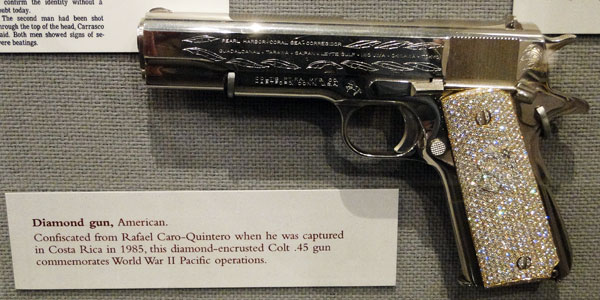
Diamonds are a druglord's best friend, next to drugs. (Photo By: heydayjoe)

Diamonds are a druglord’s best friend, next to drugs. (Photo By: heydayjoe)

Each of these drug enforcement predecessors had a touch of seizure fever. Although they were all opposed to people taking drugs, none had any qualms about forcefully taking away people’s drugs – and anything else they found next to or in the same house or in the general vicinity of those drugs. Confiscated treasures on display at the DEA Museum range from a homemade honey bear bong to a full-size marijuana vending machine to the diamond-encrusted Colt .45 of drug kingpin Rafael Caro-Quintero

The DEA has even managed to obtain for display a box of twisted steel and concrete chunks from the World Trade Center. What’s the connection to drugs? Here’s your answer: Poppies grow in Afghanistan; poppies are used to make heroin; heroin production fuels terrorism; and terrorists attacked the World Trade Center. Seems straightforward, right? (NOTE: None of the 9-11 terrorists were Afghani nationals, and opium production has been on the rise in Afghanistan since the U.S. occupation began in 2001.)

The original title of this 1956 mass market paperback was "Second Ending." (Photo By: heydayjoe)

The original title of this 1956 mass market paperback was “Second Ending.” (Photo By: heydayjoe)

Growing drugs isn’t always a profession of choice, but taking them usually is. Many have tried to enhance their personalities by devouring dope, but drug use typically doesn’t enhance your career – unless you’re an athlete, or a former DEA agent, or a musician. The intertwined story of drugs and music is much like the chicken or the egg causality dilemma: Although we don’t know which came first, there’s a long history of taking drugs to make music to take drugs to. The DEA Museum graciously provides some pleasant side effects of that medicinal medley. Here are some of the high notes:

  • “Marijuana enthusiasts of the 1920s called themselves ‘Vipers.’ Jazz music with lyrics about marijuana, known as viper music, was often played in basement clubs known as ‘tea pads.’ To listen to the Rosetta Howard & the Harlem Hamfats version of “If You’re a Viper,” click here.
  • Milton ‘Mezz’ Mezzrow was the jazz musician who introduced marijuana to Harlem in 1929 when the drug was still legal.” He became so well known for selling weed to the jazz cats that “mezz” became slang for marijuana, a reference that is used in “If You’re a Viper.” He was also known as the “Muggles King” – “muggles” being another slang term for marijuana.
  • Kurt Cobain makes an appearance in heavy eyeliner, included in the gallery because he “shot and killed himself while high on heroin.”
  • Perhaps the greatest song featured in the museum is one created by the Partnership for a Drug Free America. Check out the video below.

Don’t forget to the visit the DEA Museum gift shop before you leave!

**According to the DEA, the “war on drugs” began during Ronald Reagan’s presidency, with increased penalties for even first-time drug offenders and expanded DEA powers. By the 1990s, more than half of federal prisoners were incarcerated for federal drug violations.