DC’s resident T. rex arrives at the loading dock of the Smithsonian National Museum of Natural History in the wee hours of April 15, 2014. (Photo By: heydayjoe)
You know that colossal T. rex skeleton that towers over you as you enter the dinosaur hall in the Smithsonian National Museum of Natural History? It’s a fake – but not for long. This morning at 5:30 a.m., a FedEx 18-wheeler pulled into the parking lot with the real skeletal remains of a genuine T. rex.
Federal Express – When your dinosaur absolutely, positively has to be there overnight.
For the first time since the dinosaur hall opened in 1911, the Museum of Natural History will have a bona fide Tyrannosaurus rex gracing its space. This 38-foot long, 7-ton T. rex is on loan to the Smithsonian Institution for 50 years, and we owe its discovery to a Montana woman out camping with her family.
The first bones of DC’s new T. rex were discovered in 1988 by Kathy Wankel, a rancher who found the dinosaur’s arm bones near the Fort Peck Reservoir in northeast Montana, on land owned by the U.S. Army Corps of Engineers. Christened the Wankel T. rex, the dinosaur was kept by the Corps at the Museum of the Rockies in Bozeman for nearly 20 years until it was packed up and shipped to DC.
Shipping a T. rex isn’t as hard as it may sound. In some ways, it’s like sending a care package to college. Wrap it up, put it in a box and toss the box onto a truck. Only this care package nixed the bubble wrap in favor of custom-molded plaster cradles. And it came in 16 crates in a customized FedEx truck driven by a husband and wife team. The couple left Bozeman in a 53-foot-long semi on April 11 for the more than 2,000-mile trip – and arrived on time.

Time to unpack the dinosaur (Photo By: heydayjoe)
Back in 1997, the Museum of Natural History was on the verge of getting a real T. rex — a dino named Sue. Sue, the largest and most complete Tyrannosaurus rex ever discovered, was to be auctioned by Sotheby’s to the highest bidder. The Smithsonian thought it belonged in its dinosaur collection. To bring Sue home to DC, the world’s most-visited natural history museum was prepared to spend $2.5 million. It wasn’t nearly enough. The Field Museum of Natural History in Chicago drastically outbid the Smithsonian, spending $8.3 million to bring Sue home to Chicago, where the 67-million-year-old remains the star attraction, drawing more than 6.5 million visitors.
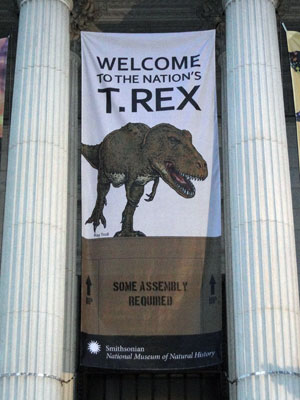
SOME ASSEMBLY REQUIRED — just like Ikea! (Photo By: heydayjoe)
Since that fated auction, the Smithsonian National Museum of Natural History has been looking for an alternative T. rex to complete its collection – until now. To make room for the big guy, the dinosaur hall will close on April 28 for a five-year renovation. When the hall reopens in 2019, the Wankel T. rex is set to be the centerpiece of a new paleontology exhibit that will showcase the giant carnivore like never before.
Now that will be something you can sink your teeth into…
[DINOSAUR BONUS: The Ohio State University marching band does a great T. rex impression. To see the beast in action, scroll to the 1:30 mark in the video below.]